
Shadow Play
Light at the End of the Tunnel Vision

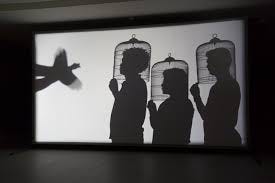
Tunnel Vision
Stopping in front of a mirror, an advertisement with the words ‘Be Who You Want To See’ painted onto its frame, he could not catch his own reflection.
Only the shadow.
It stood where he should have been. In attempting a year zero, he thought he would leave this image behind but now found it in front of him. The spectre shared his shape, his contours, yet drained him of life. A shadow that wrapped him in its clothes until it wore him and wore him out.
The Shadow
Shadows act as symbols of the unconscious. Repressed fears. Hidden desires. The externalisation of internal conflict. An image unavailable to the conscious self.
This spectre strangles all sense of temporality, circulating:
· The ghosts of the past.
· The denial of the future.
· The loss of the present.
A replacement. An erasure of the self. Movement from the background to the foreground.
Psychologist Carl Jung proclaimed, ‘Everyone carries a shadow, and the less it is embodied in the individual’s conscious life, the blacker and denser it is.’ The concealed, rejected, or unexpressed parts of personality project absence, which this figure turns into presence. It becomes all-consuming, where a person loses sight of their self.
Culture presents this as a figurative mirror: Dostoyevsky’s The Double replacing an individual with his doppelganger; Persona’s blurring of identities into one. Fight Club’s splitting of the self, returned as violence.
In all cases, the shadow envelops. They do not represent absence but usurpation by this figure. A culmination in psychological collapse.
There is no binary between these realms.
Just the lost self.

Man3
Benjamin Labatut’s The MANIAC explores John von Neumann’s conception of machine learning. His characterisation creates an inversion: he is a mechanical being who aims to humanise technology.
The abstraction of the self, born from the parents of digitalism and neoliberalism. Self-branding sees individuals adopt the manners of corporations. A commodification enhanced by digital tools.
Sylvia Wynter defined this as Man2, the current iteration of humanity: the neoliberal homo economicus. The self does not matter. Only the outcomes it creates.
The current landscape fuels the next version: Man3. Humans taking the form of the digital sphere: datafied entities tied to spectacular social media, subservient to the whims of artificial intelligence.
The human left in the shadow of technology. To walk away from the self to become someone else.
This collapsing binary between man and machine does not create symbiosis. It creates a shadow where life once was.
A Light at the End of the Digital Tunnel
Within this digital light, turning away from this shadow leads to a denial of reality. Turning towards it, however, does not mean growing in its image.
Jung spoke of integration. And, in these times, that takes on a posthuman narrative. A hybrid. A cyborg. An assemblage.
In essence, it is becoming with one’s shadow. To capture the environment. Namely the self in this state. Reality without filters. A mirror.
Only then does true reflection emerge.
Ironically, via refraction.