
A Method to Madness
A Move From Reflection to Refraction

Nuclear Wind
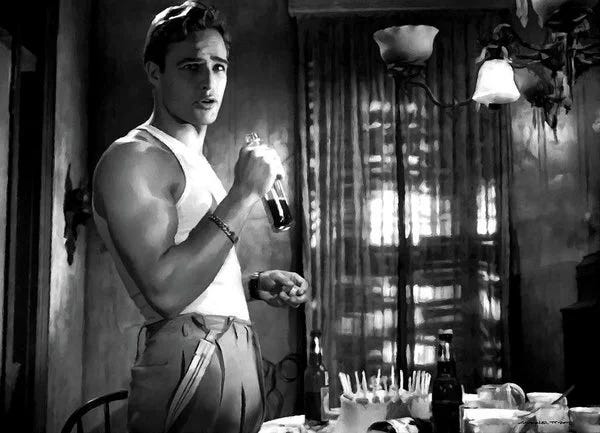
A nuclear bomb was about to hit an acting class. Disguised as chickens, most of the group flapped about panicking, cuckooing with fear. A solitary figure sat crouched in the corner, pretending to lay an egg. When asked why by his instructor Stella Adler, the figure – Marlon Brando – replied, ‘I’m a chicken. What do I know about bombs?’
A Method
Method acting was born in Russia. Its parent Konstantin Stanislavski emphasised being, rather than becoming, the character. To use one’s affective memory to create an authentic, psychologically grounded performance. A move away from the limitation of imitation.
Robert De Niro attained a taxi license, unsurprisingly, for Taxi Driver. Adrien Brody divorced his life to live in an empty apartment for The Pianist. Jim Carrey was unable to escape Andy Kaufman’s shadow after filming Man on the Moon.
Truth can only be accessed through performance.
(Re)Presentation
There is no reality. There is no fiction. Just an endless blur of these two spheres. There is no escape from the method.
Erving Goffman’s Presentation of the Self underlines this concept. Social life as a theatrical stage, where people are actors playing a role for an audience. Built on a front stage of social norms and roles, and a backstage for rehearsing the performance.
The masks a person wears shifts depending on the situation. A mirror to the Japanese aphorism of a person having three faces:
Their public self, presented to society.
Their private self, with friends and families.
Their authentic self, revealed only to themselves.
However, there is now a fourth face: the digital self. A doppelganger that is a performance mediated by the rules of this environment.

Detournement, a Tournament of ‘Lies’
Guy Debord’s Society of the Spectacle offers the following definition of detournement:
Plagiarising the spectacle’s form to ‘exploit its expressions, delete a false idea, replace it with the right one’, taking on the system by directly challenging its very nature to expose its inner workings.
The subversive strategy builds on the audience’s familiarity with a cultural or political artifact, reproducing content on the world’s stage with a distorted meaning antagonistic or antithetical to the original.
A move beyond theory to praxis, existing ‘within culture but it points beyond it’ where dismantling an idea must lead to its reconstruction.
New ideas do not exist. They can only be repackaged. And that gifts the ‘present’.
A Subversion of the Subversion
However, the notion of detournement has been abandoned by the left.
Instead, it is the alt-right who adopted these tactics instead: transgression, subversion, counterculture. Well, with none of the values, rights, freedoms.
Angela Nagle asserted this shift in Kill All Normies, proclaiming this movement focused on ‘changing the culture rather than formal politics.’ The digital landscape provided a vessel to reshape the world in their own image, influencing hearts and minds to create a culture, enabling political transformation to arrive.
This enabled the mainstream mobilisation of Trump, Brexit, and Le Pen, to the extreme fringes embodied by the Groypers, 764, and the Manosphere gaining widespread prominence. After all: Culture > Politics = Power.
They were connected by a distaste and distrust of social structures, built on imitating style over substance to enforce disruption. Tactics of humour, irony, and shock within a subcultural collective concealed and extolled their extremity.
What they sold was hope. A new system against the establishment. Sociality in the age of the individual. A simplistic narrative of society. Tangible enemies within an abstract environment. The false promise of a better life.
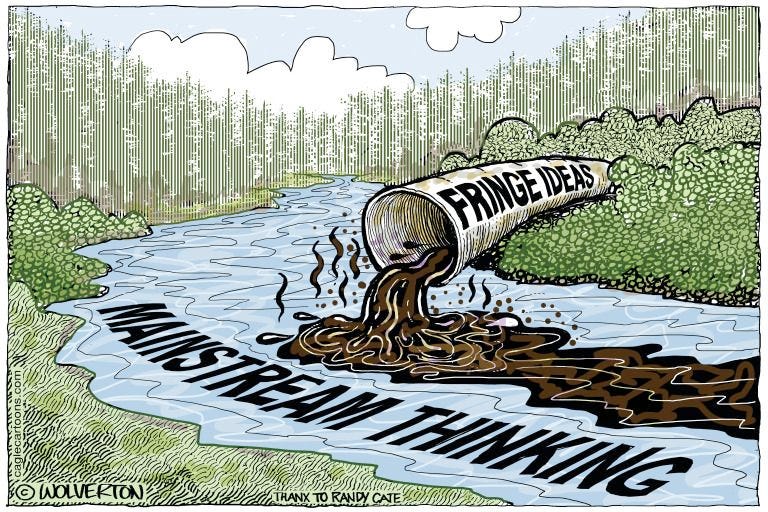
Their methods have shifted the Overton window spectacularly; the only air let in is now polluted.
Left Behind
As a result, the left got left behind.
Identity politics has failed. It tried building around the individual in the age of an image, leading to separation from the collective through its contained chambers.
The system has failed. Harris, Starmer et al are unpopular for trying to maintain a system where everyone – irrespective of political association – deems as broken.
Counter-protests have failed. They rely on old methods, being unable to attract the masses.
These rely on an old conception of politics as performance. One that does not represent the present epoch fuelled by digitalism. Zohran Mamdani and Zach Polanski have come the closest to challenging this, but these have solely been evidenced in the political, not cultural, spheres.
However, to come alive again, the methods of the past need to be buried in a coffin.
Refraction, Not Reflection
It can no longer be reflected.
Louis Theroux’s Inside the Manosphere asserted how these characters knew it was a performance. Aided by the medium, this act has become integral to their rise within the attention economy.
Paul Thomas Anderson’s One Battle After Another offered a satirical diagnosis of the political problems plaguing the world as a horseshoe. The left as focused on identity, despite their intentions of social survival and uplift; the right as nefarious, propagating surveillance, supremacy, and subjugation.
Its solution was to centre on recreating human connection, water to the fire of destructive polarisation. This provides the destination. But the journey there asserts a continuation of battle.
Instead, it can only be refracted. To change the direction of the false light perpetuated by their tunnel vision.
If method acting eschews the binary between the self and character, detournement collapses the boundary between message and medium.
A move away from critique. Transformation through distortion.
A Brief Non-Manifesto
Using the method: a movement from being to becoming, built on psychological understanding and connection.
Establishing a digital self: using the form of the present, not the past.
Reproducing the other side’s ideas to turn it against itself; giving them a new face, a different mind.
Infiltrate culture as a conduit for political change, creating a new sociality.
The world is performance: change the play that is currently being shown on this stage.
Within this nuclear wind, the question is not ‘What do I know about bombs?’ It’s how to drop a metapolitical one.